






Squibb Group Ltd v London Pleasure Gardens Ltd & Anor
Squibb Group Ltd v London Pleasure Gardens Ltd & Anor [2013] EWHC 3275 (TCC)
Contents |
[edit] Introduction
Collateral contracts were the focus of this case and formed the thrust of the claimant’s argument to obtain payment from the funder.
Collateral warranties are an example of a collateral contract. They are normally in writing and grant certain rights to the beneficiary of the warranty, most importantly the right to sue the granter of the warranty for breach of the contract to which the warranty is collateral and typically, in funder warranties, the right to step in to the main contract in place of the employer and pay for the remainder of the works. It is this right that was in contention as well as purported assurances by the funder to pay monies under the main contract.
See collateral warranties for more information.
[edit] Background
Around the time of the 2012 Olympics one of the defendants, London Pleasure Gardens Ltd (“LPG”) won a competition to develop an area of land in East London as part of a plan to provide temporary use of sites around the Olympic park. The London Borough of Newham (“LBN”), the other defendant, had a vested interest in promoting the success of the Olympics as a tool for regenerating the borough and therefore agreed to provide funding to LPG of £3,000,000.
LPG let the groundworks contract for the site to the claimant contractor, Squibb Group Ltd (“Squibb”). Works were completed on time but substantial payments were due to Squibb from LPG under their contract which LPG were unable to honour having gone into administration after the commencement of the Olympics leaving Squibb’s contractual payments and LBN’s loan outstanding.
Squibb commenced legal action contending that LBN was liable for its outstanding payments pursuant to its contract with LPG. Its claim was based on:
- A collateral contract arising at the time of conclusion of the contract between LPG and Squibb in May 2012.
- A contract or collateral contract on the basis of meetings that occurred on 5 and 11 July 2012.
[edit] Court’s findings
The court found on the evidence that no collateral contract arose between the parties in May 2012.
Squibb had then focussed its arguments on the basis of two important meetings: 5 July and 11 July 2012. By this point Squibb was threatening legal proceedings against LPG to recover its debt.
The meeting of 5 July was convened between Squibb and LBN to discuss the outstanding sums due by LPG’s failure to pay. Squibb alleged that verbal assurances were given at the meeting by LBN in order to secure completion of the works in time for the Olympics and to avoid any reputational damage to the project.
The judge, Mr Justice Stuart-Smith, declared that on the evidence, there was no “quid pro quo” on the part of LBN for Squibb’s forbearance from issuing legal proceedings or its continued co-operation. He found that LBN offered no assurance of payment to Squibb in return for its forbearing and agreement to undertake further works. Witness evidence as well as emails following the crucial 5 July meeting strongly supported LBN’s case. No contract or collateral contract was therefore found to exist on 5 July 2012.
By the 11 July meeting matters had deteriorated financially for Squibb whilst LBN were anxious to see the completion of the site and avoid jeopardising the reputation of the project. Both sides were under immense pressure with Squibb feeling the strain from its suppliers.
Squibb relied on its contemporaneous meeting notes and subsequent emails as evidencing a binding agreement with LBN to pay £250,000 towards the outstanding debt. The judge found that LBN did make contractually binding assurances to pay that sum to influence Squibb to undertake additional works (and to make advance payment for such works) and to refrain from issuing proceedings. Such assurances persuaded Squibb to carry out the additional works which it would not have done had advance payment not been forthcoming.
[edit] Conclusion
For a while it appears that Squibb was clutching at straws but it was fortunate to secure payment for part of its outstanding debt thanks to being able to demonstrate good written records around the important meeting date of 11 July. It failed to prove its case for the existence of a collateral contract where it alleged that LBN were obliged to step in to its contract with LPG and assume the payment obligation. Step in is only ever a right, not an obligation, exercisable at the beneficiary’s discretion. Circumstances will always dictate whether an assurance arose, be it express or implied, but clear and cogent evidence will be required to establish an implied assurance. Where such assurances are to be relied on they should always be in writing, as should guarantees which are otherwise unenforceable.
This article was created by construction lawyer --Najma Dunnett as part of an ongoing series of legal articles. Follow Najma on Twitter to keep up to date with the latest changes in construction law @NDunnett_Cons.
[edit] Find out more
[edit] Related articles on Designing Buildings Wiki
- Contracts.
- Collateral warranties.
- Definition of collateral warranty.
- Practical considerations of collateral warranties.
- Scheme for Construction Contracts.
- The Contracts (Rights of Third Parties) Act.
[edit] External references
- BAILII, the decision in full.
Featured articles
Check out some of the best features and news from Designing Buildings as well as key stories from around the web.
Undervaluing our industrial past

Heritage value changes as taste for building styles changes.
Changing expectations around competence and compliance

New information sheet from CIAT.
Grenfell investigation files passed to CPS

Angela Rayner apologises on behalf of the British state.

Electrical contractors need to understand the practical implications.

The real barrier to getting more value from digital technology.

Your guide to The Construction Reset at UKCW Birmingham.

Accommodating the Victorian and Edwardian working woman. Book review.
Rethinking passive fire protection in design

PFP demands the same level of design rigour as structure or services.

38% of Gen Zs feel safe when a fire door is wedged open.
Stunning images from around the world

Shortlist for CIOB’s Art of Building photography competition.

Guidance for conversion of traditional pre-1919 stone buildings.
Industrial heritage in the Ruhr
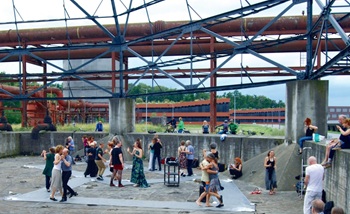
A marked difference to the fate of industrial landscapes in the UK.
Comments
To start a discussion about this article, click 'Add a comment' above and add your thoughts to this discussion page.